
Thailand: Supply and Demand of the World's Second Largest Producer of White Goods
The global home appliance market is vast, particularly in developing countries and emerging markets, where demand is continually expanding. In recent years, domestic enterprises in China have accelerated their “going global” initiatives, a trend that has become even more prominent amid the buoyant external sales and sluggish domestic sales this year.
To better align with this trend and enable domestic home appliance enterprises to quickly understand overseas markets and seize development opportunities, Industry Online, leveraging its years of data accumulation in global market research, has launched the “Overseas White Goods Market Series of Special Reports.” Today, we present the first installment of this series—the Thailand White Goods Market Report.
Commonly perceived as a picturesque tourist destination with a thriving Buddhist culture, Thailand holds another lesser-known distinction in industrial development: it is the second-largest manufacturer of white goods (air conditioners, refrigerators, washing machines) globally, after China. How did Thailand attain this position, and what are the unique characteristics of its local market? Let’s start by examining China’s exports of white goods to Thailand.
China’s Exports to Thailand: Growth Across All Three White Goods
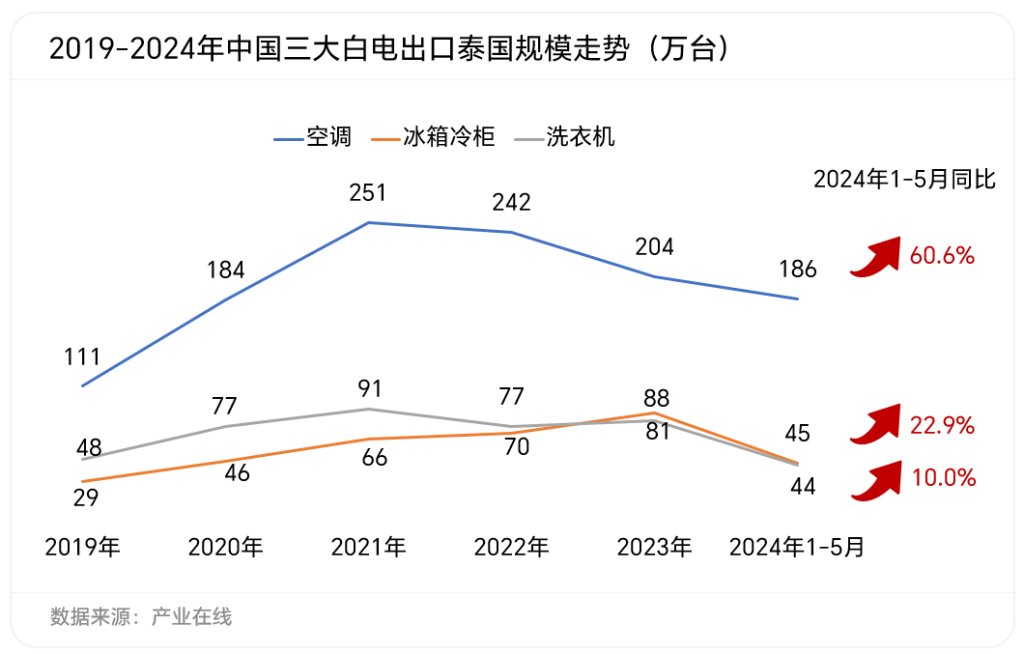
Thailand and China enjoy a long history of economic and trade exchanges, with China being Thailand’s largest trading partner for consecutive years. From China’s export data for January to May 2024, Thailand stands out as one of the few countries where all three white goods categories experienced export growth. Due to differing product characteristics, the market rhythms for each category’s exports to Thailand also vary.
- Air Conditioners: China’s air conditioner exports to Thailand surged significantly during the initial stages of the pandemic in 2020-2021, mainly due to the severe impact on local manufacturing and an increased reliance on foreign imports. Despite market consolidation in 2022-2023, demand for air conditioners in Thailand remained robust, with Chinese brands rapidly gaining market share due to their high cost-effectiveness. This year, fueled by hot weather, exports in the first five months grew by over 60% year-on-year.
- Refrigerators: Demand for refrigerators has been growing annually, as Thailand’s domestic production primarily focuses on single- and double-door small-to-medium-sized models. In recent years, there has been a rising demand for larger refrigerators with multiple doors, leading to increased imports from China and other countries.
- Washing Machines: Although the Thai market’s demand recovery for washing machines has been slower, China’s export growth has gradually picked up. In the first five months of this year, despite not experiencing the explosive surge seen in Europe and the Americas, washing machine exports to Thailand still grew by 10%.
Thailand’s White Goods Demand: Low Market Penetration
Understanding a country’s industrial market involves analyzing several macro-level dimensions: economy, population, and consumer market.
- Economy: According to the World Bank, Thailand is a middle-to-high-income country with a population of approximately 71.9 million and a per capita GDP of $6,908.8 in 2023. As a traditional agricultural country, agricultural products are a significant source of foreign exchange earnings. Thailand is China’s fourth-largest trading partner, export market, and import source within ASEAN, while China is Thailand’s largest trading partner.
- Population: Thailand’s population has continued to grow over the past decade, characterized by a large total population, a relatively balanced gender structure, pronounced aging trends, significant urban-rural structural changes, and demographic challenges. Thailand is classified as a preliminary aging society, with around 35% of the population aged 55 and above.
- Home Appliance Development: Thailand’s home appliance industry has a long history. In terms of white goods penetration, refrigerator ownership exceeds 90%, indicating near-saturation, while air conditioners and washing machines still have relatively low penetration rates. Each product category has distinct market demand characteristics.
Thailand’s domestic white goods market sees the highest demand for air conditioners, with annual demand consistently exceeding 3 million units since 2021. Despite the pandemic’s hit to the tourism sector, Thailand’s summer temperatures continue to rise due to global warming, making air conditioners a rigid demand and presenting robust growth opportunities.
Refrigerators are the most prevalent white goods in Thailand, with demand fluctuating around 2.5 million units annually, primarily driven by replacement purchases. The local market is dominated by low-to-mid-end double-door models, while three-door and multi-door refrigerators hold a smaller share. Only a minority of refrigerators produced in Thailand are sold domestically, with Japanese brands occupying a significant market share. In recent years, Chinese brands have increased
However, Thailand’s home appliance production is mainly geared towards export markets rather than domestic sales.
According to industrial online data, Thailand’s total white goods production capacity currently ranks second globally, after China. This is primarily due to the recent restructuring of the global white goods manufacturing industry chain, with Thailand successfully undertaking factory capacity transferred from Japan, South Korea, and China.
Most of Thailand’s white goods production bases are located within the Eastern Economic Corridor (EEC), which connects the three regions of Chachoengsao, Chonburi, and Rayong in Thailand, focusing on the development of manufacturing industries including automobiles and home appliances. In recent years, Chinese enterprises have accelerated their overseas expansion of production capacity, particularly in air conditioners, with a leading compound growth rate; refrigerators and washing machines have remained relatively stable, with a total production capacity of approximately 10 to 12 million units.
Judging from the production trends over the past five years, as a major producer of white goods, Thailand’s production fluctuations are basically in line with the rhythm of changes in global demand for white goods. Air conditioners have seen significant fluctuations due to the global pandemic and inflation, but overall, there is a trend of high growth; refrigerators experienced a period of rapid production growth from 2020 to 2021, with strong demand from Europe and the United States during the pandemic driving significant increases in production, entering a period of inventory reduction and adjustment in 2022-2023; washing machines are mainly supplied to Southeast Asian countries and North America, with stable scale.
Based on the current market conditions, industrial online predicts that the future development of Thailand’s white goods industry will exhibit the following trends:
Further capacity expansion: As the second-largest producer of white goods globally, Thailand’s annual white goods production scale is approximately 30 million units, but most are for export. Benefiting from multiple free trade agreements, Thai exports enjoy generalized system of preferences (GSP) treatment in countries such as the United States, Switzerland, Norway, Russia, and the Commonwealth of Independent States, coupled with its geographical location, policies, and demographic advantages, making it an excellent destination for Chinese white goods enterprises expanding overseas. In the next three years, it is expected that domestic enterprises will continue to expand their air conditioner production capacity in Thailand. The production capacity of refrigerators and washing machines will remain relatively stable, and due to policy factors such as tariff barriers, capacity utilization will further improve.
Growth in local demand: According to the World Bank’s forecast, in 2024, consumption and investment will continue to play important roles in Thailand’s economic growth. Private consumption expenditure in the first quarter grew by 6.9% year-on-year, primarily due to the robust growth of tourism and the service industry. As the penetration rate of air conditioners and washing machines in Thailand is still low, and there is significant room for refrigerator replacement, with the weakening of inflation and the recovery of residents’ willingness to spend, it is expected that local demand for white goods will maintain steady growth.
Obvious consumption segmentation trends: According to industrial online research, the consumption segmentation trend in Thailand’s white goods market is evident, with consumers demanding high-cost-performance products, which are also significantly influenced by changes in income levels. Local consumers are also sensitive to promotional discounts and pay close attention to tax reductions and subsidy policies introduced by the government. Recognition of e-commerce and social media is continuously improving. Chinese home appliance enterprises can fully integrate local market characteristics to formulate overseas expansion strategies that conform to the local market. However, Thailand’s home appliance production is mainly geared towards export markets rather than domestic sales.
According to industrial online data, Thailand’s total white goods production capacity currently ranks second globally, after China. This is primarily due to the recent restructuring of the global white goods manufacturing industry chain, with Thailand successfully undertaking factory capacity transferred from Japan, South Korea, and China.
Most of Thailand’s white goods production bases are located within the Eastern Economic Corridor (EEC), which connects the three regions of Chachoengsao, Chonburi, and Rayong in Thailand, focusing on the development of manufacturing industries including automobiles and home appliances. In recent years, Chinese enterprises have accelerated their overseas expansion of production capacity, particularly in air conditioners, with a leading compound growth rate; refrigerators and washing machines have remained relatively stable, with a total production capacity of approximately 10 to 12 million units.
Judging from the production trends over the past five years, as a major producer of white goods, Thailand’s production fluctuations are basically in line with the rhythm of changes in global demand for white goods. Air conditioners have seen significant fluctuations due to the global pandemic and inflation, but overall, there is a trend of high growth; refrigerators experienced a period of rapid production growth from 2020 to 2021, with strong demand from Europe and the United States during the pandemic driving significant increases in production, entering a period of inventory reduction and adjustment in 2022-2023; washing machines are mainly supplied to Southeast Asian countries and North America, with stable scale.
Based on the current market conditions, industrial online predicts that the future development of Thailand’s white goods industry will exhibit the following trends:
Further capacity expansion: As the second-largest producer of white goods globally, Thailand’s annual white goods production scale is approximately 30 million units, but most are for export. Benefiting from multiple free trade agreements, Thai exports enjoy generalized system of preferences (GSP) treatment in countries such as the United States, Switzerland, Norway, Russia, and the Commonwealth of Independent States, coupled with its geographical location, policies, and demographic advantages, making it an excellent destination for Chinese white goods enterprises expanding overseas. In the next three years, it is expected that domestic enterprises will continue to expand their air conditioner production capacity in Thailand. The production capacity of refrigerators and washing machines will remain relatively stable, and due to policy factors such as tariff barriers, capacity utilization will further improve.
Growth in local demand: According to the World Bank’s forecast, in 2024, consumption and investment will continue to play important roles in Thailand’s economic growth. Private consumption expenditure in the first quarter grew by 6.9% year-on-year, primarily due to the robust growth of tourism and the service industry. As the penetration rate of air conditioners and washing machines in Thailand is still low, and there is significant room for refrigerator replacement, with the weakening of inflation and the recovery of residents’ willingness to spend, it is expected that local demand for white goods will maintain steady growth.
Obvious consumption segmentation trends: According to industrial online research, the consumption segmentation trend in Thailand’s white goods market is evident, with consumers demanding high-cost-performance products, which are also significantly influenced by changes in income levels. Local consumers are also sensitive to promotional discounts and pay close attention to tax reductions and subsidy policies introduced by the government. Recognition of e-commerce and social media is continuously improving. Chinese home appliance enterprises can fully integrate local market characteristics to formulate overseas expansion strategies that conform to the local market.